
Our School
Welcome to SEND & Inclusion at Leamington






Meet our SEND team
At Leamington Community Primary School, our SEND & Inclusion Team is here to support every child and their family. We work together to ensure children feel safe, happy, included and supported to reach their full potential.
Our team can offer advice, guidance and practical support with SEND, behaviour, attendance, safeguarding, family wellbeing and mental health. This includes emotional regulation, social skills, mentoring, routines at home and accessing specialist services
If you have any concerns or feel your child or family would benefit from additional support, please get in touch through the school office or speak to your child’s class teacher. We are always happy to listen and help.
Some further contact details for our SENCO team.
SENCO: Natalie Boyd
Can be contacted on 0151 284 7848 via the main school office or alternatively you can email your enquiry to SENCO@leamington.liverpool.sch.uk
Deputy SENCO: Sally Tyson
(Available Monday and Tuesday during school hours)
Can be contacted on 0151 284 7848 via the main school office or alternatively you can email your enquiry to SENCOdeputy@leamington.liverpool.sch.uk
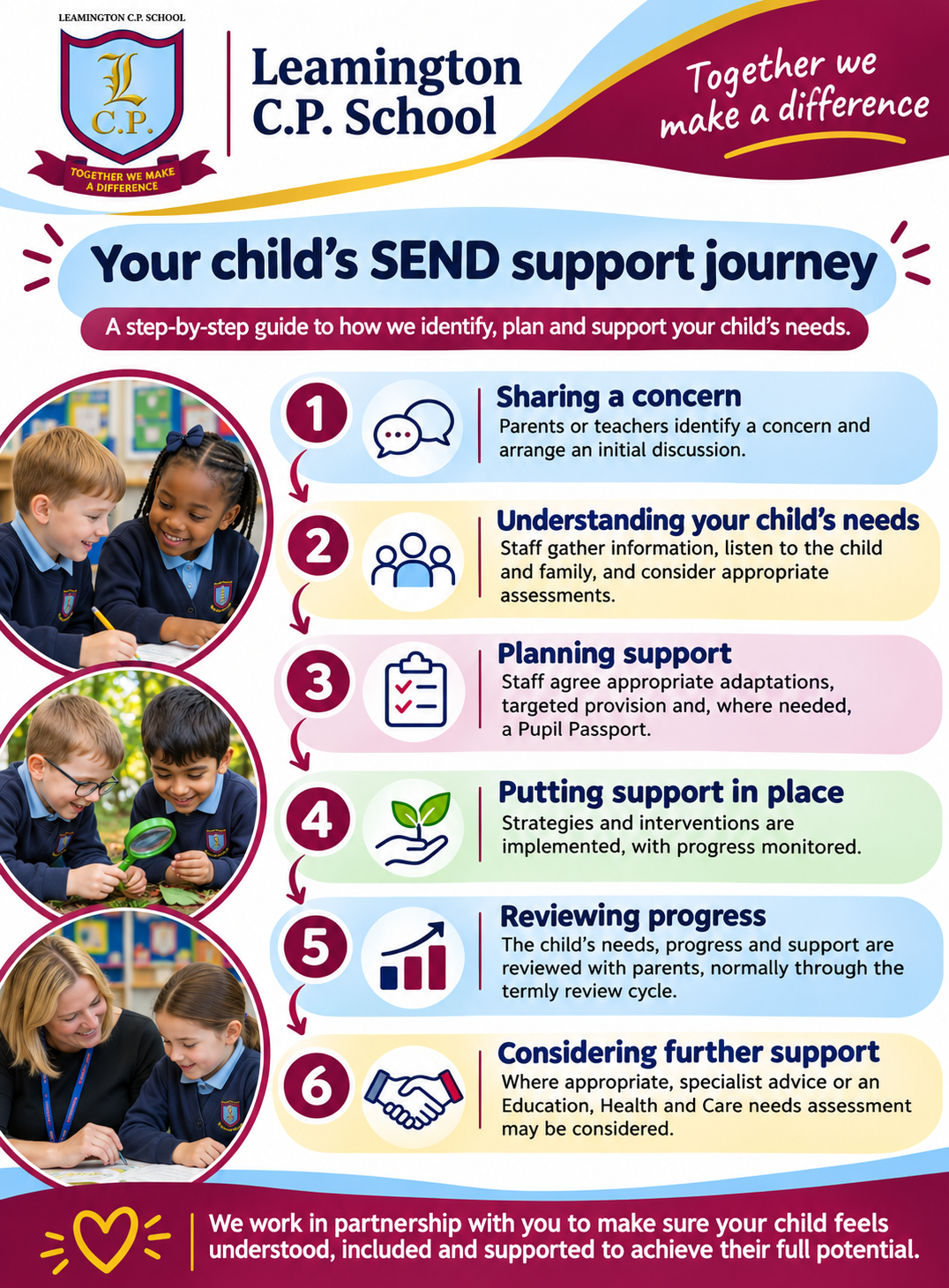
SEND Support Journey
At Leamington Community Primary School, we work closely with children and their families to ensure the right support is provided at the right time. Our SEND Support Journey follows a clear, graduated approach, beginning with identifying concerns, understanding individual needs and planning appropriate support. Through regular monitoring, reviews and collaboration with parents, we ensure that provision continues to meet each child’s needs. Where necessary, we may seek advice from specialist professionals or consider additional support through an Education, Health and Care Plan (EHCP).
Children do not need a formal diagnosis or EHCP to access SEND support, and parents can request an Education, Health and Care needs assessment themselves. We are committed to working together to help every child feel understood, included and supported to succeed.
Our SEND Provision
Universal, Targeted and Specialist Support
At Leamington Community Primary School, we recognise that every child has individual strengths, needs and aspirations. Our approach to Special Educational Needs and Disabilities (SEND) is built around high-quality inclusive teaching, early identification, personalised support and strong partnerships with families.
We offer a graduated range of provision across three levels, ensuring that children receive appropriate support to access learning, develop independence, build confidence and flourish socially, emotionally and academically.
These three waves are flexible, rather than fixed stages. Children may benefit from different types of support at the same time, depending on their individual needs.

The Nest Intervention Room
Working with families
-
SEND advice and guidance: Supporting families to understand their child’s needs, explore appropriate strategies and access additional assessments or specialist services.
-
Family support: Practical advice and emotional support from our Family Support Worker, including parenting strategies, managing behaviour and support with challenges at home.
-
Emotional wellbeing support: Access to learning mentors, pastoral interventions and external mental health professionals where appropriate.
-
Specialist services: Working with Educational Psychologists, Speech and Language Therapists, SENISS and other external agencies to provide additional advice and support.
-
Parent workshops and coffee mornings: Opportunities to meet our SEND Team, share experiences and access information from specialist professionals.
-
Coordinated family support: Where appropriate, Family Help Assessments help bring professionals together to support children and families with additional needs.
-
Pupil Passports: Parents and children contribute to personalised targets, strategies and support plans, which are reviewed three times a year.
-
Termly parents’ evenings: Opportunities to discuss children’s learning, progress, wellbeing and next steps.
-
Regular communication: Ongoing conversations with class teachers and the SEND Team through ClassDojo, email, telephone calls and meetings.
-
Assess, Plan, Do, Review: Parents’ views are actively considered when identifying needs, introducing additional provision and evaluating its impact.
-
Pupil and parent voice: We listen to children’s and families’ experiences to help shape individual support and improve our inclusive practice.
-
Specialist assessments and reviews: Families are kept informed of assessment outcomes and involved in discussions about recommendations and additional support.
Specialist Support
-
Special Educational Needs and Inclusion Support Service (SENISS): Specialist teachers provide advice, assessments and recommendations to support children with SEND. They also work with school staff to develop inclusive teaching strategies and personalised provision.
-
Educational Psychology Service: Educational Psychologists help us understand children’s learning, development, emotional wellbeing and behaviour, providing specialist assessments and recommendations to inform appropriate support.
-
Speech and Language Therapy (Alder Hey): Speech and Language Therapists assess and support children with speech, language and communication difficulties, providing strategies and programmes that can be implemented in school and at home.
-
Occupational Therapy Services: Occupational Therapists provide specialist advice and support for children experiencing sensory processing, physical coordination, fine motor or functional difficulties, helping them participate more independently in everyday school activities.
-
Physiotherapy Services: Physiotherapists support children with physical development, movement and mobility needs, advising on appropriate strategies, exercises and equipment.
-
Community Paediatricians (Alder Hey): We work alongside paediatric professionals to share relevant information and support children undergoing developmental or medical assessments.
-
Mental Health Support Team (MHST): Through our partnership with Alder Hey’s Mental Health Support Team and Educational Mental Health Practitioners, we can access advice and targeted support for children experiencing emotional wellbeing and mental health difficulties.
-
Beautiful New Beginnings: Provides therapeutic and emotional wellbeing support for some of our most vulnerable children, helping them develop emotional awareness, confidence and strategies to manage difficult experiences.
-
Sensory Support Services: Specialist professionals provide guidance and recommendations for children with hearing, visual or other sensory impairments, helping us make appropriate adaptations to the learning environment.
-
Specialist assessments to develop a clearer understanding of your child’s strengths and needs.
-
Individual recommendations to help teachers adapt learning and remove barriers.
-
Targeted interventions or therapeutic programmes delivered by specialists or trained school staff.
-
Support for families, including advice and strategies that can be used at home.
-
Staff training and professional guidance to ensure that recommendations are implemented consistently.
-
Ongoing reviews to monitor progress and evaluate the effectiveness of additional provision.
Parent FAQs & Resources
How can we help you and your child?
SEND Parent and Carer Support Hub | Leamington Community Primary School
At Leamington Community Primary School, we understand that every child’s learning journey is different. We recognise that parents and carers know their children best, and we are committed to working together to ensure every child feels happy, safe, included and supported to achieve their full potential.
Whether you have concerns about your child’s development, would like to understand the support available in school, or need advice about accessing additional services, our SEND and Inclusion Team is here to help.
Below, you will find answers to some of the questions parents and carers ask most frequently.
Frequently asked questions
- What should I do if I think my child has SEND?
If you have concerns about your child’s learning, communication, development, behaviour, emotional wellbeing or sensory needs, we encourage you to speak to their class teacher in the first instance.
Your child’s teacher will listen to your concerns, discuss how your child is managing in school and consider whether additional support or assessment may be helpful.
Where appropriate, the teacher may refer your child to our Special Educational Needs Coordinator (SENCO) for further assessment and advice. Parents and carers will be involved throughout this process.
You can also complete our Leamington SEN Concern form for parents to share your concerns directly with the SEND Team.
We believe that identifying needs early and working together gives children the best opportunity to succeed.
2. Does my child need a diagnosis to receive SEND support?
No. Your child does not need a formal diagnosis to receive additional support in school.
At Leamington, support is based on each child’s individual needs rather than whether they have a medical diagnosis.
If your child is experiencing difficulties with learning, communication, emotional regulation, sensory processing or other aspects of school life, we can introduce appropriate adaptations and interventions to help.
For example, children may benefit from visual timetables, sensory resources, adapted learning activities, small-group interventions or additional emotional support without having a diagnosis of autism, ADHD, dyslexia or another condition.
We use a graduated approach, known as Assess, Plan, Do, Review, to identify needs, introduce support and monitor progress.
3. What is a Pupil Passport?
A Pupil Passport is an individual support document used for children identified as having special educational needs.
It helps staff understand your child’s strengths, individual needs, barriers to learning and the strategies that will support them.
Each Pupil Passport includes specific, measurable targets and details of the additional support or interventions your child may receive.
At Leamington, Pupil Passports are developed with input from children, parents and teachers and are reviewed three times a year, usually once each term.
Parents and carers are invited to contribute to their child’s Pupil Passport and discuss how they can support their child’s progress at home.
4. How will I know whether interventions are helping my child?
We regularly monitor and review the effectiveness of the additional support children receive.
Depending on your child’s needs, this may include assessments, classroom observations, intervention records, progress towards individual targets and feedback from your child.
Our teachers, Learning Support Officers and SEND Team work together to evaluate whether interventions are making a positive difference.
We review Pupil Passports termly and share information about progress with parents and carers. Where an intervention is not having the intended impact, we consider whether the support needs to be adapted or whether further advice or assessment is required.
We measure success not only through academic progress, but also through improvements in confidence, independence, communication, emotional wellbeing and participation in school life.
5. What is an EHCP and how can I request an assessment?
An Education, Health and Care Plan (EHCP) is a legally binding document for children and young people who need special educational provision that may require support through an EHCP.
An EHCP identifies a child’s educational needs, the outcomes they are working towards and the provision required to support them.
Most children with SEND have their needs met through the support available within their mainstream school. However, where a child has more complex or persistent needs, an Education, Health and Care needs assessment may be appropriate.
Who can request an assessment?
Parents and carers have the right to request an EHC needs assessment directly from their local authority. Schools can also make requests.
The local authority must normally decide within six weeks whether to carry out an assessment. Where an EHCP is agreed, the final plan should normally be issued within 20 weeks of the original request. An assessment does not automatically result in an EHCP.
Our SENCO can explain the process, discuss your child’s needs and help you understand the evidence available from school.
For more information, visit GOV.UK — Education, Health and Care Plans.
6. How does school support children with autism, ADHD, speech and language difficulties or dyslexia?
At Leamington, we recognise that children with similar diagnoses may have very different strengths, needs and experiences. We therefore focus on understanding each child as an individual and providing support that responds to their specific barriers to learning.
Depending on individual needs, support may include:
- Autism: Predictable routines, visual timetables, clear communication, structured learning environments, sensory adaptations and support with social communication and emotional regulation.
- ADHD: Chunked instructions, movement breaks, visual prompts, structured routines, reduced distractions and strategies to support attention, organisation and self-regulation.
- Speech and language difficulties: WellComm screening in Nursery, targeted language activities, visual communication resources, vocabulary development and support informed by Speech and Language Therapists.
- Dyslexia and literacy difficulties: Dyslexia screening where appropriate, multisensory teaching, additional literacy interventions, IDL, coloured overlays, reading rulers and adapted recording methods.
Our SEND Team also works with specialist professionals, including SENISS, Educational Psychologists and Speech and Language Therapists, where additional assessment or advice is needed.
Our aim is to remove barriers to learning while maintaining high expectations for every child.
7. What support is available for children who experience anxiety, emotional or sensory difficulties?
We understand that some children find aspects of school life challenging, particularly busy classrooms, social situations, transitions, unfamiliar routines or overwhelming sensory environments.
At Leamington, children’s emotional wellbeing is an important part of our inclusive approach.
Depending on individual needs, support may include:
- Regular emotional check-ins and trusted adult relationships.
- Zones of Regulation and strategies to help children understand and manage their feelings.
- Individual or small-group mentoring.
- Sensory resources, movement breaks and sensory circuits.
- Access to quieter spaces or sensory environments.
- Visual supports, predictable routines and preparation for changes.
- Personalised strategies for managing anxiety and emotional regulation.
- Additional support from our Inclusion and Wellbeing Team or external mental health professionals.
For a small number of identified Reception and Year 1 children, The Nest provides a nurturing, structured environment for targeted interventions, emotional regulation and additional support.
We work closely with families to understand what children may be experiencing and identify strategies that help them feel safe, comfortable and ready to learn.
8. How can I access SEND support outside school?
There are a number of organisations and services available to support children with SEND and their families.
Our SEND and Inclusion Team can provide information, advice and signposting to relevant services. Where appropriate, we can also work with external professionals to request specialist assessment or support.
Some useful organisations include:
Liverpool SEND Local Offer
Information about SEND services, education, health, social care and support for children and young people aged 0–25.
Explore Liverpool’s SEND Local Offer
Liverpool and Knowsley SENDIASS
A free, impartial and confidential service providing information and advice to parents and carers about SEND support, EHCPs, assessments and educational rights.
Visit Liverpool and Knowsley SENDIASS
ADDvanced Solutions
Provides information, workshops and support for families of children with neurodevelopmental differences, including autism and ADHD.
Young Person’s Advisory Service (YPAS)
Offers mental health and emotional wellbeing support for children, young people and families in Liverpool.
Liverpool Parent and Carers Forum (LivPaC)
A parent-led forum representing the experiences and views of families of children and young people with SEND.
Contact our SEND and Inclusion Team
We’re here to listen, advise and support.
If you have any concerns about your child’s learning, development or wellbeing, please get in touch. We welcome the opportunity to work with you.
SEND Documents
Leamington SEND Profile – Leamington Community Primary School SEND Profile
Leamington SEND Policy – SEND Policy
Leamington SEND Information Report – SEND Information Report
Important links: